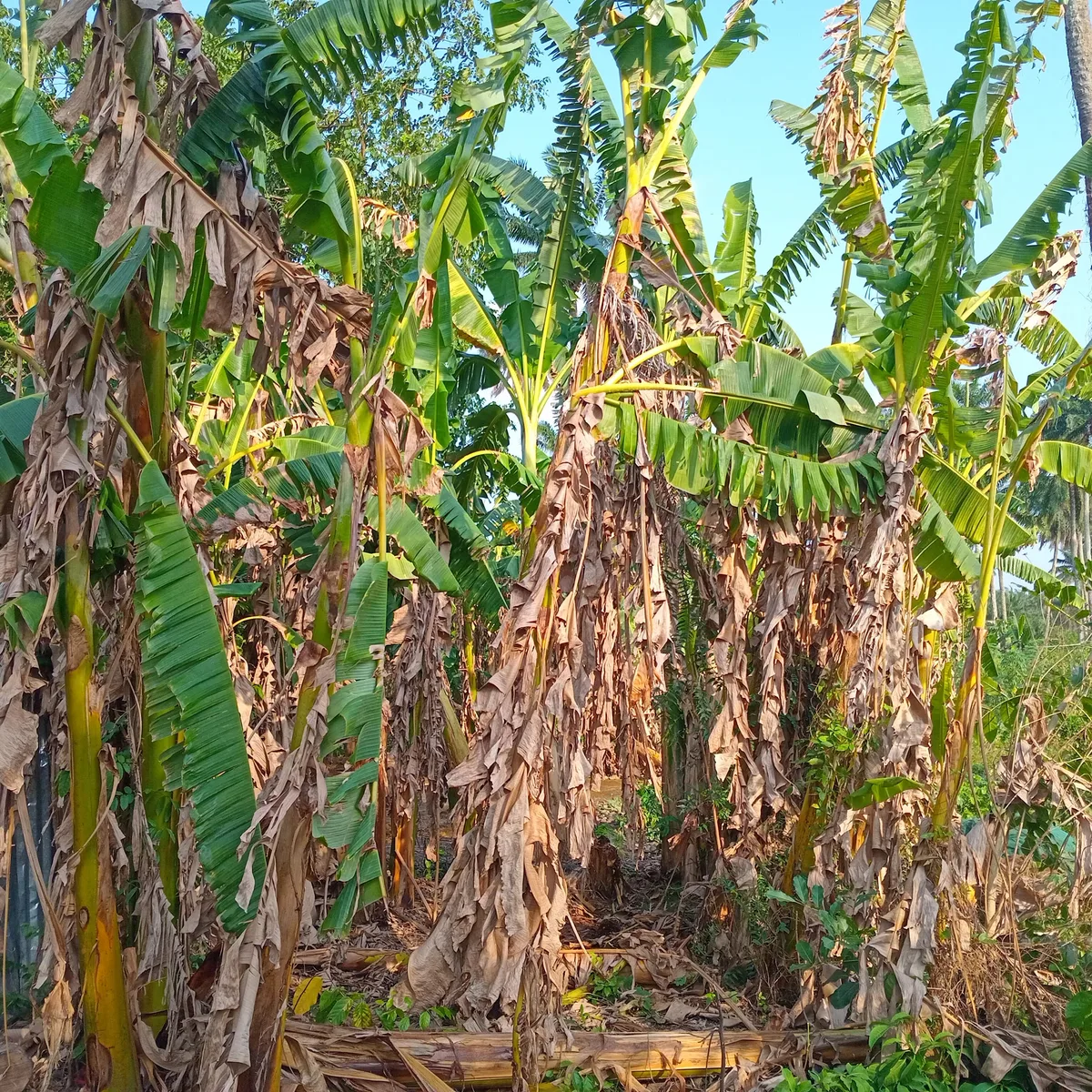
Banana
Musa spp.
Family: Musaceae
Banana grows in full sun and prefers deep, fertile, moisture-retentive but well-drained loam rich in organic matter. Water needs: High; maintain consistent soil moisture during active growth and fruit filling while avoiding prolonged waterlogging.
Photo Gallery
Plant reference images showing growth stages and identifying features.
Photo info
Photo info
How to Grow Banana
Banana growing information includes sunlight requirements of Full sun, soil conditions listed as Deep, fertile, moisture-retentive but well-drained loam rich in organic matter with a soil pH of 5.5-7.0, and High; maintain consistent soil moisture during active growth and fruit filling while avoiding prolonged waterlogging water needs. The listed hardiness zones are 9-11. For propagation reference, the database lists germination or establishment information for Banana as Edible bananas are normally propagated vegetatively rather than germinated from seed; wild or seeded Musa can have slow and irregular seed germination, with planting or establishment depth listed as Seed sowing is uncommon for edible bananas; vegetative starts are planted with the corm and roots securely covered while keeping the growing point above the soil surface. Days to maturity are listed as Banana plants commonly require about 9-18 months from planting to harvest under warm, favorable conditions, depending on cultivar and climate.
Plant Overview
Banana (Musa spp.) is listed in the Musaceae family and categorized as a fruit with a perennial herb life cycle. This profile summarizes growing information for hardiness, light, soil, water, seed starting, maturity, and other available cultivation details. Difficulty is listed as Moderate.
- Plant ID
- PLT-0113
- Family
- Musaceae
- Plant type
- Fruit
- Life cycle
- Perennial herb
- Growth habit
- Large clumping perennial herb growing from an underground corm, with overlapping leaf sheaths forming a pseudostem
- Mature height
- Commonly about 6-20 feet, depending on cultivar and growing conditions
- Mature spread
- Commonly about 6-12 feet per clump as suckers develop around the parent plant
- Difficulty
- Moderate
Growing Conditions
Banana is listed for full sun conditions. Water needs are listed as high; maintain consistent soil moisture during active growth and fruit filling while avoiding prolonged waterlogging. The database soil reference is Deep, fertile, moisture-retentive but well-drained loam rich in organic matter. The listed soil pH range is 5.5-7.0, and the listed hardiness range is 9-11.
- Hardiness zones
- 9-11
- Sunlight
- Full sun
- Soil
- Deep, fertile, moisture-retentive but well-drained loam rich in organic matter
- Soil pH
- 5.5-7.0
- Water needs
- High; maintain consistent soil moisture during active growth and fruit filling while avoiding prolonged waterlogging
- Plant spacing
- Allow roughly 8-12 feet between full-size plants or clumps, with closer spacing possible for compact cultivars
Seed & Germination
For propagation, the database note is edible bananas are normally propagated vegetatively rather than germinated from seed; wild or seeded musa can have slow and irregular seed germination. Planting-depth guidance: Seed sowing is uncommon for edible bananas; vegetative starts are planted with the corm and roots securely covered while keeping the growing point above the soil surface. The listed time to maturity is Banana plants commonly require about 9-18 months from planting to harvest under warm, favorable conditions, depending on cultivar and climate. Use these values as general reference points and adjust for local climate, seed source, and growing conditions.
- Germination
- Edible bananas are normally propagated vegetatively rather than germinated from seed; wild or seeded Musa can have slow and irregular seed germination
- Germination temperature
- Seeded Musa germination generally favors warm conditions, while edible cultivars are normally established from suckers, corm divisions, or tissue-cultured plants
- Seed depth
- Seed sowing is uncommon for edible bananas; vegetative starts are planted with the corm and roots securely covered while keeping the growing point above the soil surface
- Sowing method
- Usually established from a sword sucker, corm division, or tissue-cultured plant rather than from seed
- Start indoors
- Young banana plants can be started or maintained indoors in warm, bright conditions, especially where outdoor temperatures are too cold
- Transplanting
- Plant suckers or tissue-cultured plants at approximately the same depth they were growing previously, keep the corm firmly covered, and minimize root drying or damage
Harvest & Propagation
- Days to maturity
- Banana plants commonly require about 9-18 months from planting to harvest under warm, favorable conditions, depending on cultivar and climate
- Harvest
- Harvest the bunch when fruits have filled out, become more rounded, and show the maturity characteristics of the cultivar; bunches are commonly cut while still green and allowed to ripen after harvest
- Propagation
- Edible bananas are normally propagated vegetatively from sword suckers, corm divisions, or tissue-cultured plants rather than from seed
- Seed saving
- Most cultivated dessert bananas are seedless and do not provide useful seed for propagation; seeded Musa types can produce viable seed, but seedlings will not reproduce seedless cultivars
- Pollination
- Most cultivated dessert bananas produce seedless fruit without pollination; wild and seeded Musa types may depend on animal pollinators such as bats or birds
Garden Information
- Common pests
- Banana weevil, burrowing nematodes, aphids, thrips, mites, scale insects, and other sap-feeding or root-feeding pests
- Common diseases
- Panama disease caused by Fusarium, black Sigatoka, yellow Sigatoka, banana bunchy top virus, moko disease, and other fungal, bacterial, or viral diseases
- Uses
- Fresh fruit, smoothies, baking, desserts, cooking, drying, chips, purees, and tropical edible landscapes
Find, buy, swap, or sell Banana
One World One Seed connects this plant profile to community sellers, plant swaps, storefronts, and participating garden retailers.
Growing Reference Note
Plant performance can vary with climate, soil, weather, cultivar, seed quality, and gardening methods. The values on this page are general database reference ranges rather than a substitute for local extension guidance or seed-packet instructions.